Monday, May 14, 2007

is protest dead?

a few weeks ago some friends and i quickly organized a protest and boycott-- not in response to the ocean-qway human rights violations we're usually protesting-- but because of a bread-and-butter scandal affecting our university that's gotten lots of coverage in our local press.

the day before, most of the people we handed fliers to in the breezeway were familiar with the issue.

this was a welcome change from darfur activism. it felt empowering to be part of a movement that had palpable potential to cause change. and this change could, for once, be immediate. no UN resolutions necessary.

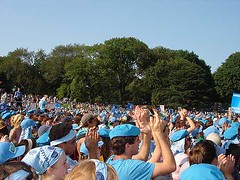
but then...no one came to the protest, aside from the core organizers and our friends. There were more press than people, their cameras' clicks sometimes louder than our improvised chants. In stead of participating, my fellow students at my commuter school gawked at us in the hallway, framing cell phone photos, and edging by us to slip coins into the vending machines we told them them to boycott.

needless to say, this poorly attended press-spectacle was a bit of an embarassment fo me, one of its organizers. i replayed the past few days in my head looking for mistakes, but could find none: we had publicized efficiently and thoroughly; we had sent mass e-mails and made masses of photocopies; we had garnered the attention of every press outlet in the area.

and yet somehow our protest had alienated the people we had hoped most to inspire: the students of our school.

this led me to question the very nature of protests in general. Do they alienate people who aren't activists, people not used to yelling at causes?


the rebellious romantic in me mourns this. sure phonecalls can be effective but they aren't as adrenaline-rush-inspiring as picketing and marching and sitting-in. In my mind, if activism were a big university, protesting would be its football-- the thing everyone celebrates and cheers at and contests.

(no offense to any sports fans here,) but, like football, is protesting just a big fun spectacle or does it actually get stuff done? And the even more unnerving question i keep asking myself is if we are just alienating potential activists by being so..."in your face" about causes? or would we be defiling the nature and legacy of activism if we got out of everyone's face?

in short, is protest dead?

Encouraging the media to face up to genocide

We learn from Jerry Fowler's November 2006 interview with Ann Curry:

"Ann also highlights the importance of public response, noting that the more emails and feedback a story receives and the more the public cares about a story such as Darfur, the more likely the outlet is to continue covering the region."

Tonight, ABC News released two Darfur news stories: "Darfur: Trying to Save the Capital" and "How You Can Help Save Darfur."

So, click on the Comments and Suggestions page at ABCnews.com and let ABC news know you appreciate Darfur coverage. The human rights community must not let genocide go unnoticed, and our ability to spread the word rests largely on the media.

The failures of international organizations: the case of Zimbabwe

This week Zimbabwe, the country with the world's largest inflation rate, was elected to lead the Commission on Sustainable Economic Development (CSD) at the United Nations. This represents the failure of the international community on a number of levels.

First, giving a leadership position at the United Nations to a dictatorial, repressive, floundering government only gives international legitimacy to that government, and says the world doesn't care if governments harm their own people - they're still fit to help lead the rest of the world on an incredibly important issue.

Second, the CSD is the body charged with ensuring global "Development that meets the needs of the present without compromising the ability of future generations to meet their own needs," according to its own mission statement. When Zimbabwe currently "has the world's fastest shrinking economy outside a war zone... inflation is running at 2,200 percent...and the nation, once a regional breadbasket, faces acute shortages of food, hard currency, gasoline and most basic goods" (IHT) promoting Zimbabwe to head a sustainable development institution just makes no sense. It says that the international community doesn't really care about sustainable development, it just wants to pour a bunch of money into an office and some programs to pretend it does.

Why did this happen?
"It seems developing countries voted for Zimbabwe in a direct show of defiance against developed ones... Many observers believe the result was an overwhelming snub to the US and the EU by developing nations, especially those in South America, who respected both the African block's decision and their refusal to be pushed around by former colonial masters."

When countries like Zimbabwe are elected to chair the CSD, and Sudan sat on the old Human Rights Commission despite the North-South civil war and Darfur, how can we expect the UN to act effectively to protect people around the world?

Sunday, May 13, 2007

Distorting Darfur

Here's an anonymous letter from the New York Times Magazine's column "The Ethicist":

My brother, an eighth grader in a school where I am a junior, gave a speech about the genocide in Darfur to his English class. His teacher and classmates chose him to present it to the entire grade. School administrators would not let him speak unless he removed a sentence containing the word "rape," finding it inappropriate for 13-year-olds. Is this censorship, or does the school have a valid point?


Randy Cohen, The Ethicist, responds that it is right for schools to think about what content is appropriate for students to hear but argues that "A discussion of the ghastly events in Darfur must mention rape, lest the audience be significantly misinformed." I agree. Kids younger than eighth grade are exposed to misogyny and violence on television.

As my father says, we cannot sanitize the human experience. The tragedy of Darfur is that thousands of women and girls, many even younger than eighth grade, have been raped. To eliminate the word "rape" from a speech about Darfur does not deny that rape has been and is occurring there, but is does distort the truth. To distort what is happening in Darfur insults the memory and dignity of the victims of Darfur. As activists, my fellow board member Elizabeth Milligan wrote in an earlier post, we have the responsibility to educate others about Darfur in order to combat misinformation. Telling the truth about Darfur is our moral obligation.

Friday, May 11, 2007

What I’m Reading V - Darfur Investigation

The genocide in Darfur is old enough that books are starting to be published about it. The best one that I’ve seen so far is “Genocide in Darfur: Investigating the Atrocities in the Sudan,” (2006) edited by Samuel Totten and Eric Markusen. By far the largest and most scholarly volume published on the subject to date, the contributors are a who’s who of big names in the genocide prevention community. Even the COC’s own Jerry Fowler lends a chapter.

Totten and Markusen include a bit of historical information on Sudan and the crisis in Darfur, but they committed most of the book to the history and process of the Darfur Atrocities Documentation Team that interviewed refugees in Chad and whose information gathered led Colin Powell to make the historic accusation of genocide against Sudan in September 2004.

A lot of space is given to analyzing why the United Nations and other groups have not made similar findings, as well as what the significance of the US findings are. This book is absolutely required reading for anyone who wants to understand the genocide in Darfur, how it was discovered, the world’s reaction to it, and its implications for future genocides.

Transcending realism with hope

Holocaust expert speaks on relationship between politics and genocide - News

See the above article about Jerry Fowler in the Oregon Daily Emerald, or just contemplate his quote:

"We may never have a world without genocide, but that doesn't absolve us of the responsibility as witnesses to speak out and have the hope and the imagination that lives could be saved because of what we do."

STAND high school students have such a vision. They'll be taking part in a media advocacy event called "Picture a World Without Genocide." To learn more, click on www.standnow.org/picture_a_world.

Tuesday, May 8, 2007

Tanzania's Unannounced Expulsion of Refugees


Going on a year now the government of Tanzania has expelled persons of Rwandan and Burundian descent according to an article from Reuters news service. The article reports that in the process upwards of 15,000 people (a vast majority of whom are from Rwanda) have been forced to leave. What is most shocking about this is not that those being expelled are refugees (though that would certainly be shocking enough) but that even some who have lived in Tanzania all their lives, having been born to parents from Rwanda or Burundi, are also being targeted.


Thanks to Human Rights Watch the president of Tanzania, Jakaya Kikwete (pictured), has heard word that the world will not stand idly by and watch this flagrant abuse of the mandates governing the protection of refugees. Since it is not party to the Convention Relating to the Status of Refugees but since it is a member-state of the United Nations I am not sure what legal implications would apply here but what Tanzania is doing is certainly unsettling.


Article 1 (full-text of the Convention to be found here) requires that, "The Contracting States... apply the provisions of this Convention to refugees without discrimination as to race, religion or country of origin." That's strike one. As for subsequent strikes, look to Article 32, which states that refugees cannot be expelled unless it's for reasons of national security, one must have been given "due process" before being expelled, and that one must be given sufficient opportunity to seek refuge in another state.


As I said I don't know what the legal ramifications would be in this case since Tanzania is not party to the Convention. However, according to the article Allison des Forges of HRW seems to think that what Tanzania is doing is "in serious violation of international law." At the very least I think that what Tanzania is doing is morally reprehensible and it should be made to think twice about removing the welcome mat for these people who have gone through so much.

Keeping the Heat on this Summer

For most of us, the school year is winding down or already over and summer’s starting. For me, graduation time is here and I’m done with university. Just because summer vacation is here doesn’t mean that it’s time to take a break from advocacy. There are still a few people around campus and everyone counts, so make sure to get the message about Darfur to them.

Better yet, this is a great opportunity to make yourself a better advocate. Let your summer reading enrich your knowledge of Darfur and genocide in general. Learn new techniques for spreading the word and networking with other advocates.

Keep the pressure on Sudan, the companies that invest there, and your own government representatives.

Remember, genocidaires don’t take a break and mass atrocities aren’t seasonal. The people committing them shouldn’t get the summer off from opposition just because we do.

Wednesday, May 2, 2007

2 new books on Darfur

For academic reasons and personal interest I have recently finished reading two new books on Darfur. One focuses on what happened on the ground, the other on US citizen responses. They are both incredibly important additions to our understanding of the Darfur crisis.

The Devil Came on Horseback: Bearing Witness to the Genocide in Darfur by Brian Steidle and Gretchen Steidle Wallace is the story of Captain Steidle's year as an observer with the African Union Mission in Darfur. The book is an earnest account of attacks Steidle witnessed and investigated, and the photographs section is particularly powerful. It's a must-read to understand what life on the ground for Darfuri civilians was like during some of the worst of the genocide in 2004.

Sample quote:
"It is one thing to attack people in their village; it is another thing entirely to attack an IDP camp. THese people had already been driven out of their homes violently and had established a camp of last resort - and act of desperation as they sought to meet their basic needs and find safety. But even that was to be denied them by the GOS and the Janjaweed militias. I was convinced: This was systematic ethnic cleansing. This was genocide." (p. 79)


Not On Our Watch: The Mission to End Genocide in Darfur and Beyond by Don Cheadle and John Prendergast is a book that does two things - it chronicles the work of activists and advocates to start what is now a true citizens movement for Darfur, and it lays out ways that individuals can help end genocide. The book is also peppered with the thoughts and commentary of the authors, which provides an often amusing insight into what makes two of Darfur's greatest champions tick. (For more of my thoughts on the book see here). Also, portions of the proceeds go to the new camapaign ENOUGH).

Sample quote:
"We can use the Six Strategies for Effective Change: Raise Awareness, Raise Funds, Write a Letter, Call for Divestment Join an Organization, and Lobby the Government. With these tools, we can build the network, increase pressure on the United States and other governments to act quickly and appropriately, and ensure that the political costs for inaction will always be too great." (p. 223)

Photo: student board members Sara Weisman and Martha Heinemann Bixby with Not on Our Watch co-author Don Cheadle

Sunday, April 29, 2007

Water water nowhere


This semester I took geology in order to get my physical science requirement out of the way. I'm not a fan of any science class, and looking at rocks is about as dull as it gets, but the class has made me look at the world in an entirely different way. I've always loved nature but I had never before realized how intertwined humans are with their environment. I know that you've heard before, in an earlier post by me and one by my fellow blogger Ana Halper, that the genocide in Darfur is rooted in a conflict over resources. One of the most important resources is water, for the simple reason that it keeps us alive. Water is hard to come by in Darfur. The Sahara desert is expanding, thanks to global warming, and causing prolonged droughts in Darfur, as well as in West Africa and the Horn of Africa. Water scarcity is also one of the many hardships facing the displaced people and refugees in Darfur and Chad. But we can help them. The American Refugees Committee (ARC), a humanitarian aid organization based in Minneapolis, has a program to build water pumps in Darfur. Next semester, when the University of Minnesota chapter of STAND begins to focus on fundraising, we'll send the money we raise to the ARC to help them build water pumps. By doing this we will help the people of Darfur, but this is an action that should be taken in other places as well. Providing easier access to water is one way we can alleviate conflict today and prevent it in the future.

On Our Toes

Sudan's green light for only part of the peacekeeping force is too little, too late, and is aimed only at defusing international pressure and heading off sanctions. Governments should keep the focus on the full international force, which could really help to protect civilians in Darfur.
--Peter Takirambudde, Africa director at Human Rights Watch

Just a few weeks ago we celebrated Sudan’s decision to allow part of the international peacekeeping force to operate within its borders. We also have heard that China has made diplomatic efforts to influence the Sudanese government on behalf of the people of Darfur.

However, our history with the Bashir government should keep us on our toes. The international community’s relationship with Sudan has followed a three steps back, one step forward model.

Bashir makes a lukewarm promise, then reneges on his promise, and we beg him to reconsider, and meanwhile people die.

We need to stay vigilant, and continue to advocate for a full international peacekeeping force. As the global days for Darfur continue, let’s keep our activist minds sharp on behalf of our Darfurian brothers and sisters!

Saturday, April 28, 2007

Displace Me

Water and saltines will be collected upon entry and redistributed. Because you have to depend on foreign aid for food in displacement camp.

Tonight, in 14 cities throughout the US, more than 65,000 people will travel to displace themselves.

A few college guys traveled to Uganda in 2003, finding children in the midst of war who commute nightly for a safe night's sleep. They walk for hours and sleep in unimaginably horrible conditions. Child soldiers are recruited by the Lord's Resistance Army (LRA). In response, three men not much older than me started the Invisible Children campaign. Their goal? To help Ugandan children. More on this in a future blog - because the campaign is genius.

So Americans will displace themselves for a night, sending a message to the US and Ugandan governments that peace talks must be resumed, the war must end, and children and civilians must be protected.

Sign up for displacement camp at a city near you.

Thursday, April 26, 2007

Rally for Darfur this Sunday!

If you're in the DC area (or a reasonable train/bus/driving distance) show up at Lafayette Park this Sunday to rally for Darfur!

Global Days for Darfur Rally at the White House
Sunday, April 29th 2:00-4:00pm
Lafayette Park
1600 Pennsylvania Ave. Washington, DC

There are also events going on across the country - and the world. Find an event near you!

It's time we show President Bush that if he wants a positive human rights legacy he must do more for Darfur - now! What should he do? Some thoughts are here and here.

(image from Hillel.org)

Wednesday, April 25, 2007

What I’m Reading IV

A single event can characterize an entire era: think of D-Day in the Second World War, or Martin Luther King’s “I have a dream…” speech during the American civil rights movement. The same goes for how a single massacre can represent a whole genocide.

Just as Auschwitz instantly leaps to mind for most people thinking of the Holocaust, the Srebrenica massacre was the culmination of the Bosnian War in many ways. One of the best books that I’ve run across about Europe’s largest post-WWII massacre is “Srebrenica: Record of a War Crime” by Jan Willem Honig and Norbert Both.

Honig and Both outline the events which resulted in the deaths of 7 000 unarmed Bosnian Muslim men in mid-July 1995 at the hand of Serb “soldiers.” Although it was written just a year after the massacre and so lacks much of the hindsight of more recent publications, “Srebrenica” is still an excellent resource that glaringly highlights both the ineptitude of the United Nations for providing global security and the weaknesses of the obsolete concept of peacekeeping that allow countless innocents to be butchered before the eyes of the world.

Sunday, April 22, 2007

The Happy Faces of Genocide

Father David Bohnsack, a Comboni missionary who spent more than 10 years in Darfur, spoke about his experience in Sudan at Lake Forest College in Chicago. He shared photographs taken of smiling people, kids playing games and climbing trees, people dancing.
I can relate to these photos. I'm just like these kids.

Father David reminded us that, in spite of genocide, Darfuris are strong, and they still find ways to dance and smile.

Human nature leads us to look at the top photo of the dying girl and think "that child has been condemned to death. She has no chance. (and thank God MY child doesn't look like that)." But tell an American the smiling girl below might be raped and shot by the Janjaweed, and see how they react differently.

So how do we convey the urgency and ugliness of the conflict while still preserving the dignity of Darfuris?

(by the way: I don't have the answer. It's why I'm asking. So you should share your comments)

Friday, April 20, 2007

I just spent the two days at Campus Camp Wellstone, an awesome student activist training camp that teaches the grassroots organizing strategies of Paul Wellstone (the coolest senator ever) and I am pumped to start using what I learned! The camp is geared toward political activists tackling a range of issues from Electoral College reform to the Obama campaign to fair trade to Darfur and focuses on running an effective campaign and effective community organizing. We spent a lot of time talking about the message of a campaign. The message is essentially what we want our audience to know. How do we build an effective message? How do we convey it to our voters or audience? I told one of the trainers afterward that I had found what we had learned helpful, but I still wasn't sure how to apply it to my work with STAND. I said that I do not think that "End genocide" or "Save Darfur" are good messages--although they are useful slogans for conveying our larger, long-term goal--because they are too vague and, let's face it, ending genocide sounds pretty unattainable.
"Well, what is it that you want students to get out of your message?" he asked.
"I guess we want them to see that yes, this is a huge issue, and very complex, but they really can make a difference," I answered, thinking out loud.
"Exactly," he said. "Action is your message. Tell them that by writing this letter or signing this postcard, they can have a tangible impact on ending the genocide."
The message that students can have an impact on state government and foreign policy is central to increasing the level of student advocacy to save Darfur, which Elizabeth blogged about a few weeks ago.

So, how am I going to use this newly-created message? On Thursday, the University of Minnesota STAND will table, but we'll do it differently than we've ever done before. We'll stand in front of the table instead of just sitting behind it, so we better actively engage in our unsuspecting advocates, and tell them they can make a difference, they can end genocide, by writing to their representatives in the Minnesota legislature, who need a little encouragement before they vote to divest Sudan.

Thursday, April 19, 2007

Imagine

Imagine this-violence happening in our own country. This violence is huge-it happened at a place of education, something our country stands for and provides for its citizens. What happened at Virginia Tech is outrageous, emotional, scary, unbelievable. What happens in Darfur, what happens in North Korea, what happens in Chechnya, what happens in Congo-it's all terrible. But what is more terrifying to me is the lack of faith in a peaceful world. I held a peace program at my school last semester, and not a lot of people came, which is usual but I heard from some people that they did not attend because they do not believe in peace. WELL of course, peace doesn't seem reasonable when it is viewed as idealistic. What we need, and take this as a personal challenge, is a little faith in a peaceful world. That faith will lead to advocacy, action, and hopefully and eventually, SUPPORT for the global society that we live in today.

Wednesday, April 18, 2007

Are you frustrated? Because I am!

Today I was reading an article in The New York Times about how the Sudenese government has been painting its own planes to look like UN and African Union planes, thus breaching U.N. Security Council resolutions. At last I thought someone will take action! How could the UN sit by and do nothing after this gross disregard for international law? Instead the UN is in essense saying "Silly Bashir, UN planes are for the UN. Next time use your own."

This evening I looked at the online New York Times and saw how President Bush had made a speech today at the U.S. Holocaust Memorial Museum about the genocide in Darfur. Yes! He finally refered to Plan B. Yes! He threatened Sudan with real sanctions. BUT HE TOOK NO REAL ACTION!

President Bush bowed to pressure from the UN Secretary General Ban Ki-moon to give the UN more time for political discourse. This happened even after the facts revealed about the Sudanese use of "fake" UN planes. Thankfully, President Bush spoke strongly. But giving Bashir "a short while" has been said before. How many "short whiles" will it take for someone to stand firm and demand results?

The time for action is now. Within the next few weeks, we'll see how far Ki-moon's negotions will go. The United States needs to take action.

What I’m Reading III

It seems to be about all that I manage to write about lately, but here’s my latest book recommendation. Maybe I should spend a bit less time reading and more time blogging…

Genocide prevention types are always fascinated by survivor testimonies and without a doubt their stories are the most important resource for understanding the impact of genocide on its victims. Projects such as the film “Shoah” and the survivor testimony archive The Shoah Project are priceless sources for the stories of people who lived through hell.

The perspective of genocide perpetrators does not get nearly as much attention, though. Maybe people find it distasteful to give a voice to the criminals of all criminals, but they are actually priceless sources of information for understanding why and how people come to commit genocide. French authour Jean Hatzfeld gives us just such a resource in “Machete Season: The Killers in Rwanda Speak.” (A follow-up to his book “Into the Quick of Life: The Rwandan Genocide - The Survivors Speak”)

The most shocking thing about Hatzfeld’s book is the sympathy that one feels reading what the small group of interviewees (now prisoners in Rwanda’s Rilima penitentiary) has to say about how the genocide affected their lives, though the book by no means absolves them for what they did or casts them as victims. Be careful to keep their crimes in mind the whole time you read this book. Aside from that, the book gives a glimpse into the minds and blurred motivations of some otherwise ordinary men who became enthusiastic monsters for a time. Their lessons are not restricted to Rwanda, but are universal.

Monday, April 16, 2007

Breaking Good News

On an otherwise tragic day we have a small bright spot of good news from the BBC:

More than 3,000 United Nations troops will be allowed into Darfur, according to Sudanese Foreign Minister Lam Akol. The apparent change of heart comes after months of international pressure, but there is no UN confirmation so far.

This is particularly important because the violence continues:

"This is the greatest concentration of human suffering in the world and an outrage that affronts the world's moral values," Penny Lawrence, Oxfam's international director said after a tour of Darfur...

For more info and analysis see Coalition for Darfur or my blog, Lives in the Balance.